






Lighting a Room: Ambient, Task, and Accent
Lighting is the design decision that's most often undersold and most often regretted. People will spend serious thought on a sofa or a dining table and then put one fixture in the middle of the ceiling and call the room done. A year later the room looks fine in photos but doesn't feel right when they're actually living in it. Almost always the answer is lighting — they have one source where they need three.
This is the post I find myself talking through with customers in the store more than almost any other. Here's the short version of what I'd tell you standing in the room with a notepad.
The three layers — all of them, every room
A well-lit room has three layers of light, and they each do a different job:
-
Ambient is the overall fill light. It's the base layer — a ceiling fixture, a flush mount, or evenly-spaced recessed lights. This is the layer most people stop at, and it's the layer that does the least to make a room feel inhabited.
-
Task is light directed at where you actually do things. Reading by a chair. Prepping food on a counter. Getting dressed. Without task light, you end up cranking up the ambient brightness to compensate, which is what makes a room feel like an office.
-
Accent is decorative or atmospheric light that adds warmth, depth, and a focal point. Table lamps, wall sconces, picture lights, candle-style fixtures. This is the layer that makes a room feel like someone lives there rather than just being lit.
Any one of these on its own is wrong. The combination of all three, all on dimmers, is what makes a room. Below is how I'd think through each of the four rooms people ask me about most.
Living room
Skip the single ceiling fixture if you can. A flush mount works in a small living room (under about 14 feet on the long wall); for anything bigger, several smaller sources beat one big one. The goal is even fill without hot spots.
For task light, put a floor lamp next to each main reading position — the sofa arm where someone actually reads, the favorite chair. An adjustable arm matters here more than a fixed one. For accent, put table lamps on the side tables, a sconce or two over the sofa or beside a piece of art, and one decorative fixture (a sculptural floor lamp or a statement table lamp) that earns its place by how it looks even when it's off.
A common mistake: every lamp in the room at the same height. Vary it. A floor lamp at 60 inches, a table lamp at 28 inches, a sconce at 64 inches — different eye lines make a room feel three-dimensional instead of flat.
Dining room
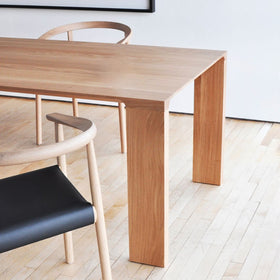
In a dining room the pendant or chandelier over the table is doing double duty as ambient and as the focal point. Hang it 30 to 36 inches above the tabletop (not the floor). Lower than that and the fixture cuts the table in half visually; higher than that and it stops feeling like a dining-room fixture and starts feeling like a hallway light.
Width matters too. A pendant or chandelier should read about half to two-thirds the width of the table. A 71-inch table wants a fixture or fixture cluster in the 36 to 48 inch range. Two smaller pendants spaced evenly along the length are a good option for longer tables and lower ceilings.
For accent in a dining room, a buffet lamp on the sideboard, a wall sconce, or a small lamp on a corner console — something at 28 to 36 inches that catches the eye when the dimmer is low and the candles are lit. That's the layer that makes a dinner party look like a dinner party.
Kitchen
The kitchen is the one room where overall fill light matters most, because you need to see what you're doing everywhere — at the stove, at the sink, on the counter at the far end. Use recessed lights spread evenly across the ceiling, or a single flush mount in a small kitchen.
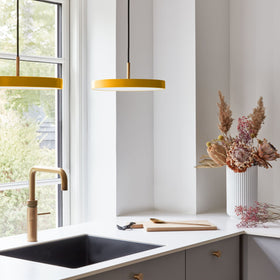
Task is two things in a kitchen: under-cabinet lights along the counter run, and pendants over the island. Pendants over an island hang at the same 30-to-36-inch rule above the counter (not the floor) — same as the dining-room rule. Two or three pendants spaced evenly along the island look better than one big fixture.
For accent, a small lamp on the counter (the corner near a coffee setup, or the end of the run near a cookbook shelf) makes the kitchen feel warmer at night and gives you a way to leave a low light on after everyone's gone to bed.
Bedroom
In a bedroom the ambient layer can be small. A flush mount is fine; you don't need a statement piece overhead. Where the bedroom earns its lighting is in task and accent.
For task, a lamp or sconce on each side of the bed. Sconces save bedside-table real estate, and a sconce that swivels is the most useful version because it puts the light where the person reading is rather than in the middle of the bed. For accent, a small lamp on the dresser, a picture light over a piece of art, or a single floor lamp in a reading corner. The bedroom is the room where one carefully-placed accent light, on a dimmer, outperforms ten ceiling fixtures.
Home office
The home office is the room where bad lighting is the most expensive. Eye strain costs you real working hours, and a poorly-lit video call costs you a different kind of credibility. Most home offices are lit with one ceiling fixture and a single desk lamp, and almost none of them are lit well.
For ambient, plan a little more fill light than you would in a living room of the same size — you're doing close work for hours at a stretch. A flush mount or a couple of recessed cans is usually enough. Skip a low-hung pendant in an office; anything in your peripheral vision while you're at the screen will pull your eye away.
The task layer is where the office earns or loses you. A directional desk lamp with an adjustable arm, positioned opposite your writing hand — lamp on the left if you're right-handed, on the right if you're left-handed — so your hand doesn't cast a shadow on what you're reading. If you mostly work on a screen rather than on paper, the lamp's job is different: aim a soft directional source near (not at) the wall behind the monitor. That reduces the contrast between the bright screen and the dark wall, which is the single biggest cause of office eye strain.
Accent in a home office is doing a job most people don't think about: video calls. A small lamp at eye level, in front of you and slightly to one side — not overhead, not behind you — makes you look like a person on Zoom rather than like a silhouette. A picture light over the art behind your desk works for the same reason. Both should be on dimmers so you can dial them in by time of day.
One last thing about offices: glare on the screen is the most common lighting mistake and the hardest one to fix once the desk is placed. If you can, set the desk perpendicular to the nearest window, so the window is to your left or right rather than behind you (which silhouettes you on calls) or in front of you (which puts the brightest thing in the room on the wall behind your screen).
Dimmers — the highest-leverage move you can make
Every fixture in a living room, dining room, or bedroom should be on a dimmer. This is the single best thing you can do to a room's lighting and it's almost always cheaper than buying a different fixture. A dimmer turns a one-mood room into three or four — bright for cleaning and cooking, medium for hosting, low for an evening at home.
Modern LED dimmers are inexpensive and any electrician can install them in an afternoon. One thing to confirm: the bulbs you're using need to be dimmer-compatible. Most modern LEDs are; cheap ones sometimes aren't, and the giveaway is a flicker or a faint buzz at low settings. If you see either, swap the bulbs before you swap the dimmer.
Lumens — the number that replaces "60-watt"
If you grew up shopping for 60-watt bulbs, you're not alone. The watt was the unit everyone used as shorthand for brightness for sixty years — and it never actually measured brightness. Watts measure energy use; brighter incandescent bulbs used more energy, so wattage and brightness moved together until LEDs broke the link. A modern LED that's as bright as an old 60-watt incandescent uses about 9 watts. The wattage on a new bulb's box is now usually printed as "60W equivalent," meaning "as bright as the old 60-watt bulb you used to buy."
The number that actually measures brightness is lumens. Here's the rough conversion most customers find useful when they're shopping for replacements:
-
40W incandescent ≈ 450 lumens. Bedside reading, accent lamps, candle-style fixtures.
-
60W incandescent ≈ 800 lumens. The most common reference. Living-room table lamps and most fixtures with shades.
-
75W incandescent ≈ 1,100 lumens. Brighter task light — a reading lamp by a chair, a desk lamp.
-
100W incandescent ≈ 1,600 lumens. Kitchen pendants, garage, workshop. Probably brighter than you want in a living-room fixture.
One side benefit of switching to LED that's worth knowing: a fixture's wattage rating (like "60W max") refers to heat — the wiring is rated for up to 60 watts of incandescent heat. With LEDs, you can run a 100W-equivalent bulb at only about 15 actual watts. That means a fixture rated 60W max can safely hold a 1,600-lumen LED bulb, which is brighter than the original spec ever allowed. If a fixture has always felt dim to you, this is the first thing to try before replacing it.
Color temperature — the other number on the bulb box
The number on the bulb box (2700K, 3000K, 4000K) is how warm or cool the light reads. Lower numbers are warmer, more yellow, more candlelight; higher numbers are cooler, whiter, eventually bluer.
-
2700K to 3000K is the right range for living rooms, dining rooms, and bedrooms. This is the warm, lamp-light feeling — what most people picture when they imagine a room that feels welcoming.
-
3000K to 3500K works in kitchens and bathrooms, where you want a slightly crisper light to read recipes or do your makeup, but you still don't want the room to feel like an office.
-
4000K and above is for offices, garages, and workshops. Skip it everywhere else in the house.
One rule that matters more than any of the above: match the color temperature within a single room. Two lamps at 2700K plus one ceiling light at 4000K will feel jarring even if you can't quite say why. If you're replacing bulbs piece by piece, write the temperature on the box flap so the next round matches.
When in doubt, send me a photo
Lighting is the hardest of these categories to spec without seeing the room. If you're trying to figure out what's missing — or you've got a fixture you love and you're not sure where it should go — email shop@valleyvariety.com a photo of the space. Two photos are even better: one in daylight and one at night with the existing lights on. Note the ceiling height. I'll tell you what's there, what's missing, and what would actually help. No obligation.
A well-lit room is the cheapest renovation you'll ever make, and the one most likely to change how a room feels day to day. When you're ready to talk through specifics, I'll be at 705 Warren Street every day, 11 to 6 — or a short email away.
— Chuck
Related Reading
- Browse the lighting collection — current selection in the store and online; pendants, sconces, table lamps, floor lamps.
- How to Measure for a Dining Table — the companion measuring post; especially relevant before you spec the pendant.
- Choosing the Right Sofa for You — a sister post on the other furniture decision people most commonly regret.
- Finding Your Perfect Design Partner — for rooms that want a whole-room strategy, not just a sofa choice.
- Visit the Store — 705 Warren Street in Hudson, NY. Open every day, 11 to 6.
Lighting FAQ
What's the difference between ambient, task, and accent lighting?
Ambient is the room's overall fill light (ceiling fixtures, recessed lights, large pendants). Task is directed light for specific activities (a reading lamp by a chair, under-cabinet kitchen lights, a desk lamp). Accent is decorative or atmospheric light that adds warmth and depth (table lamps, wall sconces, picture lights). A well-designed room uses all three.
How high should a dining-room pendant or chandelier hang above the table?
30 to 36 inches above the tabletop, not the floor. Lower than that and the fixture visually cuts the table in half; higher than that and the fixture stops reading as part of the dining set.
How wide should a dining-room chandelier or pendant be relative to the table?
Roughly half to two-thirds the width of the table. A 71-inch table wants a fixture or fixture cluster in the 36-to-48-inch range. For longer tables, two smaller pendants spaced evenly often look better than one large fixture.
What color temperature is best for living rooms and bedrooms?
2700K to 3000K. This is the warm, lamp-light range — the right temperature for spaces meant for relaxing and entertaining. 3000K to 3500K is appropriate for kitchens and baths; 4000K and above is for offices and workshops, not living spaces.
Should every light fixture be on a dimmer?
Yes, in living rooms, dining rooms, and bedrooms. A dimmer turns a one-mood room into three or four, and modern LED dimmers are inexpensive. Confirm the bulbs you're using are dimmer-compatible — cheap LEDs sometimes aren't, and the giveaway is a flicker or buzz at low settings.
Why does my room feel dim even though I have multiple lights?
Almost always because all the light is at one height — the ceiling — and none of it is at eye level or below. Add a floor lamp next to the sofa, a table lamp on a side table, and a wall sconce or two, and the same room reads brighter even with fewer raw lumens. Eye-level light feels like more light than overhead light.
How should I light a home office?
Two layers matter most: ambient (a flush mount or recessed lights — enough fill light for sustained close work) and task (a directional desk lamp positioned opposite your writing hand, so your hand doesn't cast a shadow on what you're reading). Add a small lamp at eye level for video calls, in front of you and slightly to one side — not overhead, not behind you. If you can choose where the desk goes, set it perpendicular to the nearest window so the window is to your side rather than behind or in front of you.
How do lumens compare to old incandescent wattage?
Lumens directly measure brightness; watts measure energy use. The rough conversion: 40W incandescent ≈ 450 lumens, 60W ≈ 800 lumens, 75W ≈ 1,100 lumens, 100W ≈ 1,600 lumens. A modern LED labeled "60W equivalent" gives you about 800 lumens while only drawing about 9 actual watts. When you replace bulbs, look at the lumen number on the box rather than the wattage equivalent.