






How to Measure for a Dining Table
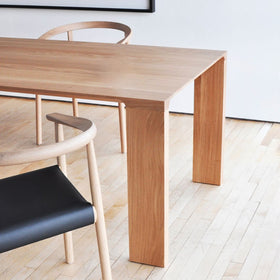
Before measuring all the ingredients for a dinner party, the most important measurement is the dining table. It's the hurdle I find most customers struggle with when we're chatting about dining tables. They need to consider both the length and width of the dining table that will fit the room while providing enough seating for daily use and special occasions.
This is a post I've meant to write for years. It's what I'd tell you standing at the table with a tape in my hand.
Chair clearance — the number most people forget
When a dining chair is pulled out far enough to sit down or get up comfortably, it needs about 30 inches from the edge of the table. That's the number to memorize.
Here's how that translates into a room. A typical rectangular dining table is about 35 inches wide. The room needs to be wider than the table by at least 60 inches — 30 on each long side — so the chairs can pull out. That's 95 inches total, or about 7 feet 11 inches wide. If someone also needs to walk behind a seated guest on one side, add another 6 inches for that side: about 8 feet 5 inches wide. If you seat at the short ends of the table too, the same 30-inch rule applies in the length direction; an 87-inch table with end seating wants a room at least 12 feet 3 inches long.
This is the rule that kills tables in narrow rooms. A 35-inch-wide table in a 9-foot-wide room leaves 36.5 inches of clearance on each side — fine for the chairs to pull out, just barely enough to walk behind a seated guest. In an 8-foot-wide room you're down to 30.5 inches each side, so chairs pull out but no one walks around. In a 7-foot-wide room the chairs barely move at all. Either narrow the table, or accept that the chairs will live pulled-in against the table and use benches on at least one side.
Another thing to keep in mind: do you plan to have a rug under the dining area? If so, the rug's dimensions matter more than the room's, because the rug defines the conceptual "dining zone." The rule I use is that the rug needs to be at least 24 inches longer and wider than the tabletop on every side. Anything less and the chairs fall off the rug when they're pulled out — uncomfortable underfoot and visually wrong.
Seating capacity — the honest version
Vendor marketing almost always overstates seating. The general rule is to plan about 24 inches of table edge per person; anything tighter than that and elbows start to overlap. Here are the numbers I'd give you if you were standing in the store with me, for the rectangular tables we stock most often:
-
A 63-inch table seats 4 comfortably, or 6 tight (good for a breakfast table or a tight dining room).
-
A 71-inch table seats 6 (this is the most versatile size — fits most dining rooms with room to spare).
-
A 79-inch table seats 8 tight, 6 comfortably (a good compromise if you sometimes host but usually eat as four).
-
An 87-inch table seats 8 comfortably (the size to get if you regularly have 8 at dinner).
-
Round: 51" diameter seats 4, 59" diameter seats 6 comfortably and 8 if people are willing to sit close.
If you're between sizes, go up one if the room allows.
Extendable tables — covering both daily and host-night seating
If your daily seating is 4 or 6 but you host 8 or 10 a few times a year, an extendable table is usually the right answer. The base size handles the everyday meal; a leaf or two takes the table up to host-night length when you need it. Three configurations are worth knowing:
-
Self-storing butterfly leaf — the leaf folds inside the base when not in use. The cleanest option, a little more expensive, and the daily-to-host transition takes about 30 seconds.
-
Drop-in leaves — the leaves live in a closet or under a bed and slot into the middle of the table when needed. The most common option and the most affordable, but you need somewhere to store the leaves.
-
Drop-leaf or gateleg — leaves hinge down from the sides of the table when not in use. Best in tight spaces where the daily-use footprint needs to disappear. A little less elegant when extended for hosting.
When you spec an extendable table, get the smallest base size that handles your daily seating — not the largest base size you can fit. Daily life on a too-large table feels awkward, and the whole point of the leaf is to disappear most of the year.
Round vs. rectangular — the short version
Round tables are more forgiving in an awkward room because no chair sticks out at the ends and the table reads smaller than it measures. Round maxes out at about 59 inches, though — above that, people can't reach the middle of the table, and you either need a lazy Susan (a commitment I don't recommend) or to accept that passing the salt becomes a project. Rectangular tables scale up, anchor a long room well, and are easier to add a leaf to. If your room is square, go round. If your room is long, go rectangular.
Whatever shape you pick, if you're going round, look for a pedestal base. A pedestal eliminates the leg-against-leg problem chairs run into with a four-leg round table, and it's far more forgiving of mismatched chair seat heights. Pedestal is the right call for almost every round table, not just for small or awkward rooms.
When in doubt, send me a photo
The honest answer to "will this fit?" often depends on things a measurement can't tell me — what else is in the room, where the doorways are, which end of the table sees the most traffic. If you're deciding between two tables or two sizes, email a photo of your dining space to shop@valleyvariety.com with your room dimensions in the email. I'll be happy to give you my thoughts. No obligation.
The table you can't quite fit is the table that doesn't work. And the table you size up to is almost always the one you're still happy with in 2036. Measure honestly, and when you're ready to talk through specifics, I'll be at 705 Warren Street every day, 11 to 6 — or a short email away.
— Chuck
Related Reading
- Browse the dining tables — the current in-store and online selection, with lead times listed on each page.
- Choosing the Right Sofa for You — a sister post on the other furniture decision people most commonly regret.
- Our Story — how Valley Variety built its dining-table selection over ten-plus years of European and domestic trade-fair sourcing.
- Finding Your Perfect Design Partner — if you want a second set of eyes on the whole room, not just the table.
- Visit the Store — 705 Warren Street in Hudson, NY. Open every day, 11 to 6.
Dining-table measuring FAQ
How much clearance do I need behind a dining chair?
Allow 30 inches from the edge of the table to the wall for the chair to pull out comfortably. If someone needs to walk behind a seated guest, add another 6 inches — 36 inches total.
How many people does a 71-inch dining table seat?
A 71-inch rectangular table seats six comfortably. It's the most versatile size for a typical US dining room and the size we stock most often.
Round or rectangular — which works better in a narrow dining room?
Round works better in a narrow or awkward room because no chair sticks out at the ends. The tradeoff is size: round tables max out around 59 inches in diameter (seats 6). If you need to seat 8, go rectangular.
How big should a dining room rug be relative to the table?
The rug should be at least 24 inches longer and wider than the tabletop on every side, so chairs stay on the rug when pulled out to sit.
Should I size up or size down if I'm between two table sizes?
Size up, if the room allows. Customers who buy the larger of two options almost never regret it; customers who buy the smaller often tell us a year later they wished they'd sized up.
When is an extendable dining table the right choice?
If your daily seating is 4 or 6 but you sometimes host 8 or 10, an extendable table covers both. Pick the smallest base size that handles your everyday meal, then use the leaf for occasions.